artWorld / 003

Hugo Simberg

An angel refuses to explain its wound.

Hugo Simberg’s The Wounded Angel: two boys carry a blindfolded angel on a stretcher through a pale landscape

Two boys carry a blindfolded angel through a real Helsinki landscape. A flower rests loosely in one hand. Blood marks one wing. Hugo Simberg offered no explanation—when he first exhibited the painting, its title was simply a dash.
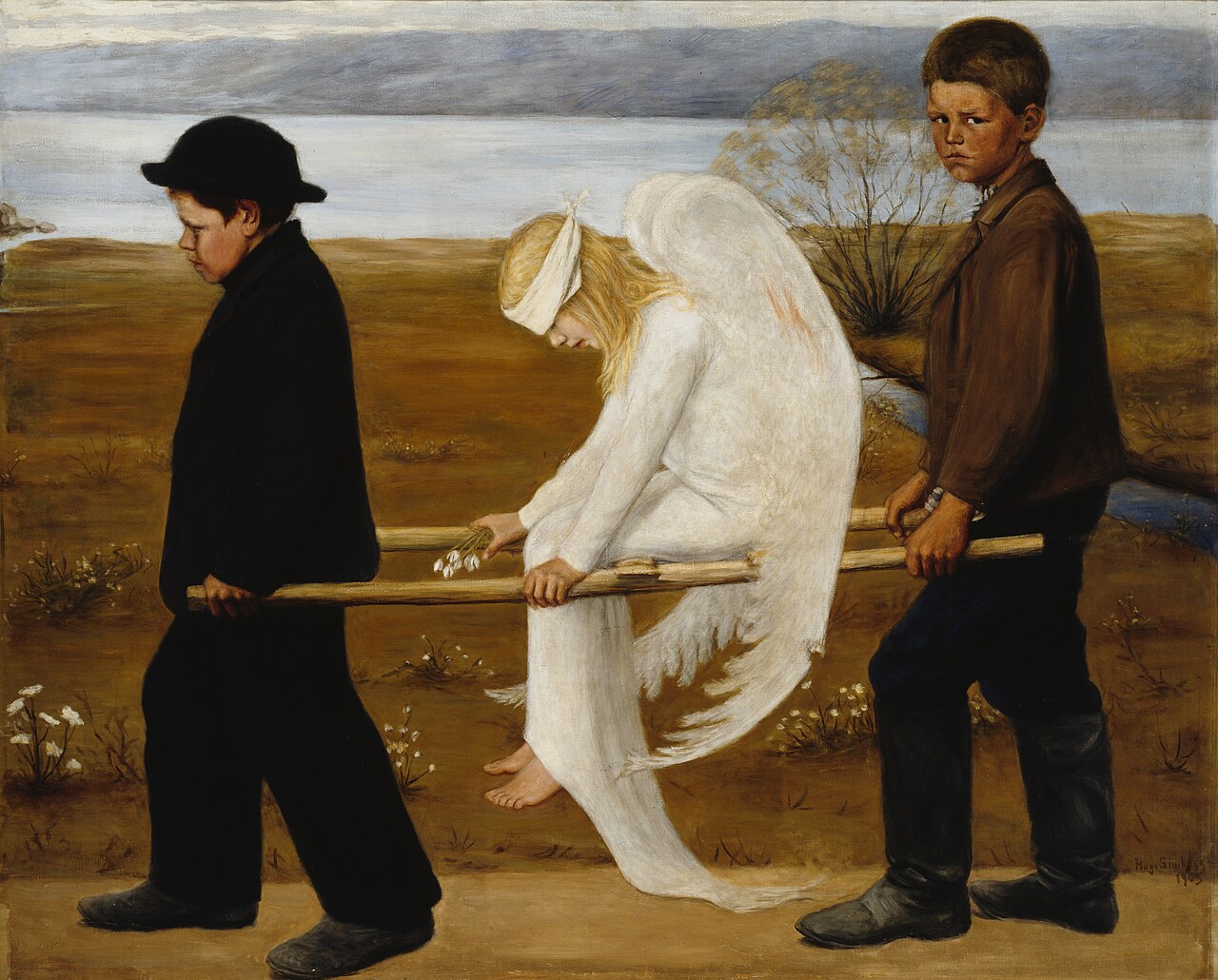
Detail of the wounded angel and its unsmiling young bearers
The sacred appears here as something fragile enough to be carried.

The scene is tender without becoming sentimental. The helpers do not look heroic; the angel does not look triumphant. Care is shown as weight, effort and uncertain direction.

Simberg filled his art with death, devils, angels and natural mysticism. His spirituality is not an escape from suffering. It is the possibility that vulnerability itself may be where the invisible enters ordinary life.

Hugo Simberg, The Wounded Angel, 1903. Ahlström Collection, Ateneum Art Museum. Photograph: Finnish National Gallery / Hannu Aaltonen. CC0 1.0 · Wikimedia Commons

Also this week

Two other positions

08

Anna Cassel

For Cassel and the women of The Five, painting was a shared spiritual practice. Her nearly one hundred works for The Saga of the Rose began as a prayer book received, they believed, from the spirit world.

Read the gallery text ↗

09

Elga Sesemann

Sesemann painted memory as atmosphere: empty rooms, quiet streets, faces fading into colour. After her husband’s death, angels, birds and solitary wings returned again and again.

See the current exhibition ↗

Growing index

All featured artists